Somewhere in your life, you have made a decision your mind could not fully justify.
You walked out of a meeting that looked perfectly fine on paper, yet something in your chest felt wrong.
You met someone and, before you had any logical reason for it, your gut quietly told you to be careful.
Or perhaps you said yes to something that made complete sense – only to notice afterwards that something within you had been saying no all along.
We usually call this intuition.
And many accomplished people have learned to distrust it.
We have been taught to value what can be explained, measured, defended and placed neatly into a spreadsheet. In that world, the body can easily become an inconvenience – something to control when it reacts, calm down when it becomes uncomfortable, and push through when it gets tired.
But what if the body is not simply interrupting your thinking?
What if it is participating in it?
That question has fascinated me for years.
And neuroscience gives us good reasons to take it seriously.
More Than One ‘Brain’
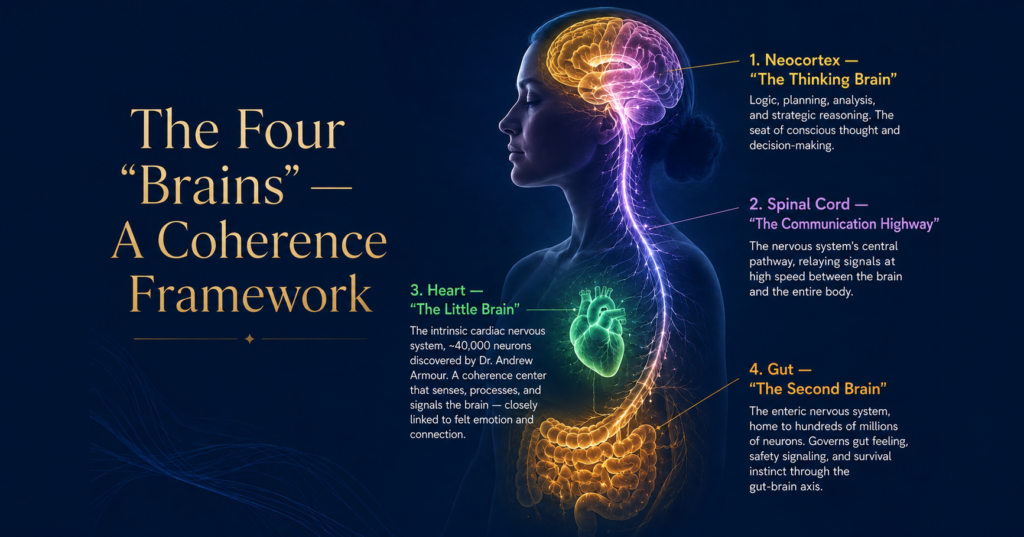
When I say that we have more than one brain, I do not mean that there are several anatomical brains inside the human body.
There is one brain.
But it is not working alone.
The heart, the gut, the spinal cord and the brain are connected through extraordinarily complex neural and physiological communication systems. Some of those systems can process information locally rather than simply waiting for instructions from the brain.
The more we understand about them, the harder it becomes to maintain the old picture of the brain as a commander sitting at the top while the body simply follows orders.
The conversation goes both ways.
And much more information travels from the body toward the brain than many of us were ever taught.
For me, this is where neuroscience becomes more than an interesting fact.
It changes the question.
Instead of asking,
‘How do I make my body stop reacting?’
we can begin asking,
‘What is my whole system trying to tell me?’
The Heart Is Not Simply a Pump
The heart has its own intrinsic nervous system – a network of approximately 40,000 neurons and other specialised nerve cells.
It can process information locally, respond to changing conditions and communicate continuously with the brain.
One important pathway is the vagus nerve.
Many of its fibres are afferent, meaning that they carry information upward from the organs of the body toward the brain.
So when your heart starts racing before a difficult conversation, your brain is not simply issuing an order that your heart obediently follows.
There is an ongoing conversation.
That racing heart does not automatically tell you what to do.
But neither is it meaningless.
It is information.
And I think that distinction matters.
Then There Is the Gut
The enteric nervous system – often called the ‘second brain’ – contains an enormous neural network running through the gastrointestinal tract. Johns Hopkins Medicine describes it as containing more than 100 million neurons; depending on how the network is measured, research estimates extend into the hundreds of millions, with a commonly cited range of approximately 100 to 600 million.
It can coordinate many digestive processes independently and uses many of the same types of chemical messengers involved in brain function.
Perhaps that makes the phrase gut feeling sound a little less poetic.
Most of us know the experience anyway.
A conversation changes, and the stomach tightens.
A decision approaches, and something drops inside us.
We hear news, and before we have consciously processed it, the body has already responded.
Again, that sensation is not necessarily truth.
A gut response may come from wisdom.
It may also come from fear, an old pattern, accumulated stress, exhaustion or previous experience.
The work is not to obey every signal.
The work is to stop automatically overriding them.
The Spinal Cord Is Doing More Than Carrying Messages
For a long time, the spinal cord was commonly described almost like a cable connecting the brain and the rest of the body.
It is much more sophisticated than that.
A rigorous stereological study published in 2018 estimated approximately 197 to 222 million neurons in the human spinal cord. It is capable of significant local processing, and some responses happen at spinal level before conscious brain processing is involved at all.
Your nervous system is therefore not waiting politely for the conscious mind to analyse every situation before responding.
Much of life is already being registered below conscious awareness.
That should give us a little humility about how much of ourselves we actually control through thought alone.
Your Body Is Constantly Reporting to You
Neuroscience uses the word interoception for our perception of what is happening inside the body.
Heartbeat. Breathing. Muscular tension. Temperature. Hunger. Visceral sensations.
The brain is continuously receiving and interpreting this internal information, particularly through regions including the insula.
This is one reason emotion cannot be reduced to ‘something happening in your head.’
What we experience emotionally emerges from an ongoing interaction between brain, body, memory, environment and meaning.
And this brings me very close to the heart of my own work.
Why This Matters to Coherence Architecture
I developed Coherence Architecture within The Shalimova Method™ as a way of understanding a journey I had seen repeatedly – in leaders I coached, in people around me, and in my own life.
A person can be highly intelligent, successful and capable, and still live with different parts of themselves pulling in different directions.
The mind says one thing.
The body says another.
Old patterns are running quietly underneath both.
Values point somewhere else again.
And outwardly, life may continue functioning perfectly well.
That is why Coherence Architecture is not about becoming better at controlling yourself.
It is about becoming able to hear yourself more clearly – and then choosing consciously what to do with what you hear.
The Architecture moves through five movements.
And I increasingly think of each movement as a question.
Awareness
What is actually happening within me?
Before we change anything, we learn to notice.
Not judge.
Not fix.
Notice.
What am I thinking?
What am I feeling?
What is my body reporting?
What pattern appears when pressure rises?
Awareness gives us something that autopilot never can: choice.
Rewiring
What pattern is running here – and is it still serving the life I am building?
Not every response we have today belongs to today.
Some were learned years ago.
Some protected us once.
Some helped us belong, perform, survive or stay safe.
But the brain is plastic.
Patterns can change.
This is where the BRAIN Method sits within Coherence Architecture – as the mechanism for recognising, interrupting and deliberately rewiring patterns that no longer support the person we are becoming.
Coherence
What happens when Spirit, Soul and Body are no longer pulling in different directions?
Here I want to make an important distinction.
Neuroscience can tell us a great deal about the integration of brain, nervous system and body.
It cannot measure the whole of the human person, and I do not ask it to.
For me, Spirit, Soul and Body describe dimensions of being human that cannot simply be collapsed into biology.
What neuroscience does show us, however, is something important: even biologically, we are profoundly interconnected.
We were never designed as a mind dragging a body behind it.
Coherence begins when we stop treating ourselves that way.
Inner Compass
What remains true when the noise becomes quieter?
The Inner Compass is not impulse.
It is not simply ‘trust your gut.’
A body signal can contain wisdom, but it can also carry fear or an old protective pattern.
That is why we listen – and then discern.
We bring together reason, embodied information, values, experience, faith and context.
And sometimes, when the noise of performance, expectation and old conditioning becomes quieter, we discover that we knew something long before we were ready to admit it.
Legacy
What am I creating through the way I choose, lead and live now?
Every decision reaches beyond the moment in which it is made.
The way a leader responds under pressure becomes part of a culture.
The way a parent lives becomes part of what a child learns about life.
And the patterns we interrupt can change what comes after us.
Legacy is not only what remains when we leave.
It is what we are building while we are here.
What This Changes About Leadership
I have spent more than two thousand hours in one-to-one coaching conversations.
And one pattern has become increasingly clear to me.
Strong leaders are not necessarily those who have learned to silence themselves best.
Often, they are the ones who have learned how to stay present enough to hear more than one source of information before they act.
Reason matters.
Data matters.
Experience matters.
And so does what is happening within the human being who is reading the data.
A tight chest before a decision is not proof that the decision is wrong.
A calm body is not proof that it is right.
A gut feeling is not a substitute for evidence.
But none of those signals need to be dismissed simply because they cannot be entered into a spreadsheet.
They belong in the conversation.
The next time something in you reacts before your reasoning has caught up, perhaps you do not have to suppress it immediately.
Pause.
Notice it.
Ask what it may be reporting.
Then bring it into dialogue with everything else you know.
That pause between reaction and conscious choice is small.
But it may be one of the most important places we ever learn to inhabit.
Because coherence does not begin when every part of us agrees.
It begins when every part of us is finally allowed into the conversation.
Resilience keeps you standing.
Coherence brings you home.
– Yevheniya Shalimova
Sources
- Armour, J. A. (1991), work on the intrinsic cardiac nervous system and neurocardiology.
- Johns Hopkins Medicine, The Brain-Gut Connection.
- Rao, M. & Gershon, M. D. (2018), Unexpected Roles for the Second Brain, Annual Review of Physiology;
- Stanford Wu Tsai Neurosciences Institute, resources on the enteric nervous system.
- Bahney, J. & von Bartheld, C. S. (2018), The Cellular Composition and Glia-Neuron Ratio in the Spinal Cord of a Human and a Nonhuman Primate, The Anatomical Record.
- Neuroscience research on interoception, the insula and body-to-brain signalling.
Love the article!
Interesting subject and wonderfully explained!